
The North East Conclave 2.0, held in Shillong, brought together policymakers, practitioners, community institutions, and development partners to advance a shared vision for scaling natural farming and natural resource management through community-led approaches. At its core, the conclave reaffirmed a simple but powerful idea: long-term agricultural transformation must be rooted in people, local knowledge, and collective ownership.
Celebrating Practice from the Ground
A key milestone of the conclave was the release of the Success Stories Compendium, which documented on-ground transformations led by farmers and Self-Help Groups (SHGs). These stories moved beyond outputs and targets to foreground lived experiences, local innovation, and the everyday leadership of community institutions in building resilient livelihoods. Together, they illustrated how natural farming is not merely a technique, but a social process driven by trust, experimentation, and shared learning.
Formalising Partnerships for Scale
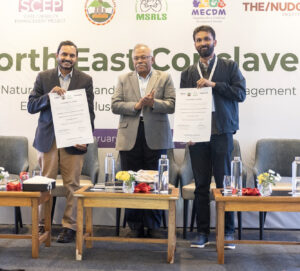
The conclave also marked the signing of a Letter of Intent for Project InSights, formalising a partnership between the Government of Meghalaya and The/Nudge Institute. The signing took place in the presence of John Paul, Senior Director, Centre for Rural Development at The/Nudge Institute, and Dr. Sampath Kumar, Principal Secretary, Community and Rural Development, Government of Meghalaya.
Implementation at the grassroots will be anchored by the State Capability Enhancement Project (State Capability Enhancement Project) and the Meghalaya State Rural Livelihoods Society), reinforcing the role of community institutions as drivers of change rather than passive beneficiaries.
Natural Farming, Nutrition, and Early Childhood Development
An Expert Masterclass on Scaling Natural Farming with the Community and a Fireside Chat on Public–Private–People–Partnerships (PPPP) deepened the conversation. Speakers drew strong links between natural farming, nutrition outcomes, and Early Childhood Development (ECD), emphasising that access to safe and nutritious food through community-led agriculture can significantly benefit pregnant women, lactating mothers, and young children.
Embedding natural farming within SHGs was highlighted as a critical pathway to address malnutrition while strengthening women’s agency and community ownership. Nutrition, participants noted, cannot be treated as a downstream outcome. It must be designed into food systems from the soil upward.
Natural Farming as a Science for Planetary Health
Discussions situated natural farming within the broader context of planetary health and the Anthropocene, underscoring the urgency of systemic change. Speakers noted that six to nine planetary boundaries have already been breached, including those related to biodiversity loss, land system change, disrupted biogeochemical flows such as excess nitrogen, and ocean acidification.
Natural farming was framed not as a return to traditional methods, but as a regenerative science that responds to these crises through ecological restoration and community systems. Technical concepts such as soil porosity, slope-driven water flow in hilly terrains, and micronutrients like selenium, required in parts per billion for human health, illustrated the deep interconnections between soil health, ecosystem stability, and nutrition outcomes.
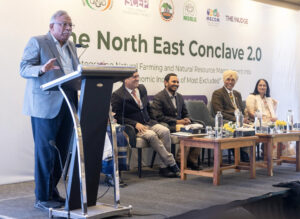
As T Vijay Kumar, Executive Vice Chairman of Rythu Sadhikara Samstha (RySS), articulated:
“Six out of nine planetary boundaries have already been breached, and agriculture must become part of the solution. Natural farming, grounded in regenerative principles and practiced in harmony with nature, offers a pathway to address these multiple emergencies. This is not traditional farming, but a new paradigm built on science, ecology, and community systems. If we want sustainable scale, the programme must be built around Self-Help Groups, because communities are the true drivers of transformation.”
Together, the reflections positioned natural farming as both a scientific response to planetary stress and a community-led pathway for long-term resilience.
Learning from Practice: Farmer-Led Scaling
Grounded examples reinforced these ideas. Practitioners shared experiences such as the creation of over 100 farmer leads in Mawthadraishan, the extension of natural farming to Makamoit village, and recognition of community practitioners through national institutions of agricultural management. These cases underscored the power of farmer-to-farmer learning and long-term handholding.
Levers for Scaling Natural Farming
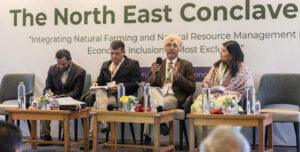
The conclave identified several critical levers for scaling natural farming sustainably:
- Government support aligned with long-term outcomes
- Knowledge systems, including protocols, videos, and field-based learning
- Social capital, especially women-led SHGs and federations
- Human capital, through farmer leaders and peer learning
- Facilitating institutions at state and district levels
- Collaboration with national and global institutions
Voluntary participation and do-it-yourself farming models were emphasised, alongside the need for long-term engagement of up to a decade in each village to ensure real behavioural and ecological change.
Looking Ahead
Emerging opportunities, such as exploring agarwood cultivation, were discussed as examples of high-value, sustainable livelihoods, with the potential for significant returns from small landholdings when managed responsibly.
Together, the conversations at North East Conclave 2.0 outlined a people-centric pathway for scaling regenerative agriculture. Grounded in community institutions, strengthened through partnerships, and aligned with nutrition and child development outcomes, natural farming emerged not just as an agricultural choice, but as a long-term development strategy for the region.