
The State Human Development Tour reached Rambrai, Nongstoin MCH and Nongstoin C&RD Block in West Khasi Hills district on 25 March 2026, bringing together district administration, frontline workers, and community institutions for a set of grounded, field-level engagements. The visit focused on understanding how existing systems are functioning on the ground and identifying practical constraints affecting delivery of health, nutrition, and social protection services.
Rather than a review of schemes, the discussions centred on how services are actually accessed, where they break down, and what enables or prevents communities from fully benefiting. A consistent pattern emerged: while programmes exist, their effectiveness is closely tied to the strength of community systems and the ability to navigate everyday barriers.
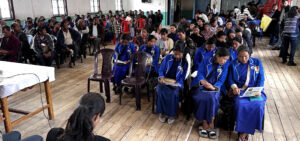
Community institutions featured prominently throughout the visit. Village Health Committees, Self-Help Groups, Village Organisations, and traditional leadership were seen not just as support structures, but as essential to how human development outcomes are shaped locally. Their role in identifying vulnerable households, supporting pregnant women, and influencing care practices was repeatedly underscored.
Conversations around maternal health revealed that decisions around institutional delivery are often shaped by practical household constraints. The question of who cares for other children during delivery continues to influence choices. In this context, the Transit Home model, supported by CGHA members, was discussed as a locally relevant solution that responds directly to this gap rather than assuming awareness alone will drive behaviour change.
Child health and nutrition discussions moved beyond service provision to focus on everyday practices. While awareness of nutrition exists, it is often limited to food intake, with less attention to feeding practices, caregiving, and early interaction. The importance of combining nutrition with stimulation, through play, communication, and engagement, was highlighted as critical to long-term development.
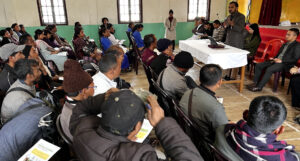
Immunisation gaps provided another insight into how behaviour evolves over time. While first children are typically fully covered, follow-through tends to decline for later children. This suggests that behaviour change is not a one-time intervention, but requires continued engagement and reinforcement at the household level.
The visit also surfaced a less visible but significant barrier: access to entitlements. Aadhaar-related challenges, coupled with limited mobile phone access, are affecting the ability of families to receive benefits across multiple schemes. These constraints are not always immediately visible within programme design but have a direct impact on service uptake and continuity of care.
Discussions on adolescent wellbeing pointed to emerging concerns around teenage pregnancy and lack of structured guidance for young people. The need for life-skills education, both within schools and through community platforms, was framed as essential to addressing these issues early and consistently.
At the systems level, gaps in coverage and capacity were also evident. Limited reach of Anganwadi Centres in certain areas, along with manpower shortages, are affecting the consistency of service delivery. At the same time, planning tools such as the Yuktdhara portal are being adopted, but challenges with data accuracy highlight the need for stronger alignment between digital systems and ground realities.
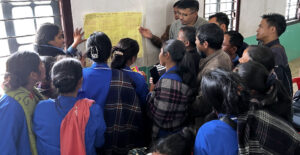
Self-Help Groups and community networks emerged as one of the more adaptable platforms within this ecosystem. Their potential to extend beyond livelihoods into health, nutrition, and social protection was clearly visible, particularly if participation can be expanded to include younger women and a broader segment of the community.
What the visit ultimately points to is a shift in where the focus needs to be. The question is no longer about introducing new schemes, but about making existing systems work more effectively in real contexts. This requires attention to small but critical barriers, stronger coordination across actors, and sustained engagement with communities.