
The first day of the Cabinet Retreat 2026 brought together senior leadership from across departments and districts to collectively reset the State’s governance compass around Mission 10 and the 10 State Commitments. The focus was clear: moving decisively from scheme-led reviews to measurable citizen outcomes, with accountability anchored at the block and district levels.
Opening Context: Why the Retreat Matters
The retreat opened with context-setting remarks by Shri Sampath Kumar, IAS, Development Commissioner, who positioned the Cabinet Retreat as a continuation of Meghalaya’s governance reform journey. Drawing lessons from the first two retreats, he reflected on action points identified and closed, underscoring the importance of sharper prioritisation and clearer outcome tracking as the reform process matures.
As he noted, “The 3rd Cabinet Retreat was positioned as a continuation of Meghalaya’s unique governance reform journey and was described as the first initiative of its kind in the country.”
He further emphasized that the purpose of convening leadership at this level was strategic and outcome-driven, stating that “The core objective of the retreat was to align senior leadership across departments and districts around shared priorities, commitments, and outcomes.”
Together, these remarks framed the retreat not merely as a review exercise, but as a deliberate step toward strengthening coordination, accountability, and results-oriented governance across the state.
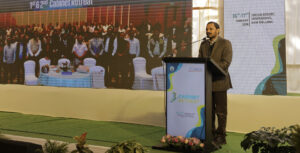
In his keynote address, Shri Conrad K. Sangma, Hon’ble Chief Minister of Meghalaya, reminded participants why such retreats are critical. He emphasised that officials, often absorbed in day-to-day service delivery, must periodically step back to understand the larger purpose of governance and the interlinkages across departments. He reiterated that “closure” does not always mean resolution, but honest documentation, redesign, or learning.
Mission 10 and the 10 Commitments
The Chief Minister, Shri. Conrad Sangma, underlined that Mission 10 and the 10 State Commitments must fundamentally shift the way governance is designed and reviewed. They must be, in his words, “Outcome-based rather than scheme-driven.”
He emphasized that commitments cannot remain confined to policy documents or departmental targets. They must be “Universal in nature, ensuring coverage up to the last-mile village.”
Further, he stressed that credibility in governance comes from clarity and accountability. Each commitment must be “Measurable, time-bound, and accountable across sectors and levels of government.”
Reinforcing this approach, the Chief Minister reminded officials that citizens do not experience administrative processes or scheme guidelines. They experience results. Therefore, governance must ultimately be judged by tangible improvements in health, education, mobility, housing, water access, and the overall quality of care in people’s daily lives.
Technical Sessions: Commitments in Action
Throughout the day, senior officers led detailed discussions on each commitment, outlining progress, challenges, and next steps:
- Effective Service Delivery and Grievance Redressal & Caring and Empowering State
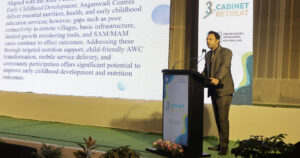
Presented by Dr. Vijay Kumar, IAS, Commissioner and Secretary, with participation from departments involved in digital governance, welfare delivery, and planning. The session highlighted the evolution of state-designed schemes, the Meghalaya Service Delivery Stack, CM Connect, Village Data Volunteers, and real-time dashboards aimed at simplifying citizen access to services. - Improved Connectivity and Mobility
Led by Shri Sanjay Goyal, IAS, Commissioner and Secretary, PWD and Transport. The presentation demonstrated how road infrastructure directly contributes to GDP growth, reduced travel time, and lower logistics costs, while outlining future projects in roads, aviation, and public transport. - Piped Drinking Water for All
Presented by Shri Pravin Bakshi, IAS, Commissioner and Secretary, Public Health Engineering Department. The session reviewed progress under the Jal Jeevan Mission, community-led water management practices, urban water challenges, and the need for institutional reforms such as a unified water utility. - Reliable and Quality Power Supply
Also presented by Shri Sanjay Goyal, IAS, highlighting infrastructure expansion, improved transmission performance, financial turnaround of power utilities, and the importance of transparent communication with citizens. - High-Speed Internet Connectivity
Presented by Shri K. L. Nongbri, focusing on broadband saturation, uncovered villages, power-related connectivity challenges, and coordination with central agencies. - Housing for All
Presented by Kum. Iaraphunlin Diengdoh, Joint Mission Director, SRES, with inputs from Rural Development and Urban Affairs. The discussion focused on completion of pending houses, convergence with basic services, and maintaining a credible permanent waiting list. - Affordable Healthcare for All
Presented by Dr. Joram Beda, IAS, Commissioner and Secretary, Health and Family Welfare, highlighting maternal and child health outcomes, community participation, data systems, and frontline capacity. - Nutrition and Early Childhood Development
Presented by Shri Sampath Kumar, IAS, focusing on an integrated ECD framework covering nutrition, caregiving, early learning, and positive parenting. - Joyful and Quality Learning at All Levels
Presented by Shri Vijay Mantri, IAS, Commissioner and Secretary, Education, and Shri Jagdish Chelani, IAS, MSSDS, highlighting joyful learning environments, teacher development, curriculum reforms, and inclusive education pathways.
Reflections from the Ground
District-level reflections were shared by Deputy Commissioners and BDOs, including Shri Abhinav Kumar Singh, IAS (West Jaintia Hills) and officers from East and West Garo Hills and Eastern West Khasi Hills. These reflections brought forward practical insights on nutrition, connectivity, service delivery, and climate resilience.
Leadership Closing
The day concluded with closing remarks by the Hon’ble Chief Minister, reinforcing the need for block-level action charts, convergence across departments, and a culture of accountability rooted in empathy and purpose.