
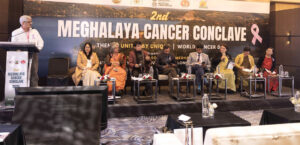
The Meghalaya Cancer Conclave 2026 convened state leadership, public health officials, oncologists, researchers, development partners, and community representatives to collectively confront one of the state’s most pressing public health challenges. With the North East bearing the highest cancer burden in the country, the conclave focused on prevention, early detection, system reforms, and the role of technology and community engagement in strengthening cancer care delivery across Meghalaya.
Across sessions, a shared message emerged clearly: cancer is no longer an episodic medical issue, but a system challenge that demands coordinated, people-centric solutions.
Leadership Commitment and Landmark Launches
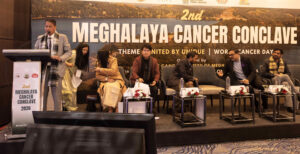
The conclave was anchored by the launch of several major state initiatives by Shri. Wailadmiki Shylla, Hon’ble Minister of Health & Family Welfare, Government of Meghalaya. These included:
- Field implementation of the Meghalaya Mission for Cancer Prevention and Early Detection
- Launch of a Cancer Screening App and screening devices, including advanced diagnostic tools
- A state-wide HPV Testing Initiative
- A collaborative Cancer Control Project with Grace Cancer Foundation, Hyderabad, initially focused on West Khasi Hills
These initiatives signal a decisive shift towards early detection, decentralised screening, and technology-enabled care, especially critical in a geographically challenging state like Meghalaya.
The conclave also marked the release of Cancer Mission Document 2.0 and the Health Atlas by the State Health Systems Resource Centre (SHSRC), strengthening the foundation for data-driven planning and evidence-based cancer care.
Cancer, Lifestyle, and the Need to Break Denial
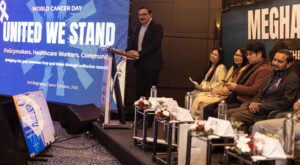
Senior leadership emphasised that denial, stigma, and late presentation remain the biggest barriers to effective cancer control. Dr. Shakil P Ahammed, IAS, Chief Secretary to the Government of Meghalaya, noted that changing social taboos, promoting early screening, and intensifying anti-tobacco campaigns are essential to reversing current trends.
The Health Minister highlighted that tobacco and alcohol use, combined with delayed detection, account for a large proportion of cancer cases in the state. He reaffirmed the government’s commitment to expanding oncology infrastructure, including increasing bed capacity to 200 beds in the cancer wing at Civil Hospital, strengthening district hospitals, and investing in specialist care.
The Human Mind in Cancer Care
A powerful session led by Dr. Sarat Adanki, Chairman- SMRATA and Ojaka Labs, brought attention to the psychological dimensions of cancer. Drawing on early research dating back to 1926, the session highlighted how emotional trauma, particularly among women, intersects with disease progression and recovery.
During chemotherapy, speakers stressed, understanding the patient’s mental state is as important as clinical intervention. The use of guided imagery and body-mind scripts, over 250 such therapeutic scripts, was discussed as an effective way to reduce distress and support healing during treatment.
Voices of Survival: From Case to Courage
One of the most moving moments of the conclave came from survivor testimonies. Bah Gordon Jyrwa shared his journey from early throat discomfort and initial misdiagnosis to chemotherapy, radiation therapy, and enduring 42 days without speech following treatment. His experience brought into sharp focus the human cost of delayed detection and the urgent need to strengthen early screening and referral systems.
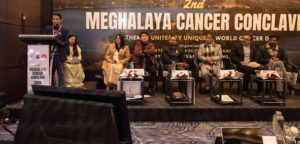
As he reflected:
“My symptoms began with discomfort in the throat and were initially treated as a gastric issue. By the time cancer was diagnosed, valuable time had already been lost. Chemotherapy began in May, followed by radiation, after which I could not speak for 42 days. Early detection could have made this journey very different.”
His words underscored a systemic lesson for healthcare delivery: when early symptoms are overlooked or misdiagnosed, patients bear the burden of more intensive treatment and prolonged suffering. The testimony served as a powerful reminder that timely diagnosis at the primary care level is not only a clinical necessity but a structural responsibility within the health system.
Another powerful reminder came from the story of Riwaka from Nongstoin, diagnosed with cancer at just nine months old in 2016. Early detection enabled timely treatment, and today, at 11 years old, she continues regular follow-ups while attending school. Her journey stood as living proof that early detection saves lives.
Recognising District Leadership
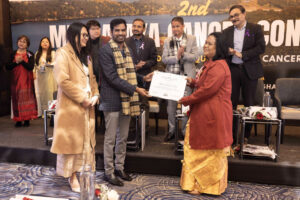
The conclave also recognised district-level leadership and performance:
- North Garo Hills received first prize for its intensified NCD screening campaign
- East Garo Hills secured second place
- South Garo Hills and South West Garo Hills were jointly recognised
Under the World Hypertension Day month-long campaign:
- West Garo Hills ranked first
- West Jaintia Hills second
- Ri-Bhoi third
These recognitions reinforced the importance of district-driven implementation and frontline leadership.
Roadmap for System Transformation
A high-level panel on “Transforming Cancer Care: From Individual Case to System Change” was moderated by Dr. Ravi Kannan, Director, Cachar Cancer Hospital and Research Centre.
Panelists noted that in 2024 alone, the North East reported 52,000 new cancer cases, with Meghalaya accounting for approximately 3,000 cases, numbers that are manageable if addressed through system reform rather than fragmented responses.
Key bottlenecks identified included:
- Delayed and inconsistent screening
- Stigma, fear, and denial leading to refusal or abandonment of treatment
- Lack of trust in the health system
- Weak referral pathways from sub-centres to PHCs, CHCs, and tertiary hospitals
- Poor utilisation of existing screening and referral data
The discussion emphasised that data exists at PHC and CHC levels, but failures in follow-up and referral completion remain the weakest link.
Levers for Change
Participants identified several critical levers within the state’s control:
- Strengthening the State Cancer Society
- Expanding self-testing kits for cervical cancer
- Using screening data actively for referral and follow-up
- Allowing greater flexibility and autonomy for field teams
- Applying outcome-based budgeting to cancer care
- Investing in community-centred communication strategies to overcome stigma
Medical colleges were highlighted as potential anchors for district-level cancer care, helping build trust and clinical capacity closer to communities.
Private and philanthropic partners, including Grace Cancer Foundation, reiterated that the return on investment in cancer care must be measured in social outcomes, not economic profit.
Towards an Integrated Cancer Care Ecosystem
The conclave concluded with a Vote of Thanks by Dr. J. S. Momin, who reiterated the urgency of early detection, innovation, and collaboration, and acknowledged cancer survivors as central voices in shaping a more humane system.
With strong political leadership, expanding infrastructure, community engagement, and a renewed focus on prevention and data, the Meghalaya Cancer Conclave 2026 marked a decisive step towards building an integrated, people-centric cancer care ecosystem for the state.